- +918330850504
- enquiry@blossomvalleytherapycentre.com
- Mon – Sat: 8:30 AM – 5:00 PM

- by admin
- August 25, 2026
- No Comments
Why Early Psychological Assessment Matters for Children Showing Signs of Developmental Regression
Why Early Psychological Assessment Matters for Children Showing Signs of Developmental Regression
Children do not always follow the same developmental path. Some may learn to speak, interact, and perform everyday activities as expected, and then suddenly begin to lose skills they had already developed. This is known as developmental regression, and it is something parents should take seriously.
Regression may appear as a loss of speech, reduced eye contact, less interest in playing with others, difficulty following instructions, changes in behaviour, or loss of previously learned daily skills. While regression can sometimes be associated with Autism Spectrum Disorder (ASD), it can also occur for other developmental or psychological reasons.
That is why a proper psychological assessment is important.
Understanding Developmental Regression Early
Parents are often the first to notice that something has changed. A child who was talking may become quieter. A child who enjoyed playing may withdraw from others. Sometimes, the changes are subtle and develop gradually.
Early developmental assessment helps professionals understand these changes instead of simply waiting to see whether the child "grows out of it."
An assessment may look at the child's communication, cognitive abilities, behaviour, social skills, motor development, attention, sensory responses, and everyday functioning. Where appropriate, IQ testing, autism assessment, or other specialised evaluations may also be recommended.
The objective is not simply to give a diagnosis. It is to understand why the child is struggling and what support can help.
Regression and Autism
Developmental regression is sometimes noticed in children with autism. Parents may observe a loss of words, reduced social interaction, repetitive behaviours, sensory difficulties, or changes in play.
However, speech delay and autism are not the same thing, and not every child experiencing regression has autism.
A professional autism assessment can help distinguish autism related characteristics from other developmental concerns. Early autism detection also gives families more time to understand their child's needs and consider suitable intervention.
Why Early Intervention Matters
Children's early years are an important period for learning communication, social interaction, movement, emotional regulation, and independence.
When support begins early, children can work on these skills while they are still developing rapidly. Depending on the assessment, intervention may include play based therapy, developmental therapy, speech therapy, occupational therapy, ABA therapy, sensory integration therapy, social skills training, or behavioral support.
For children with motor difficulties, therapy may focus on fine motor and gross motor skills. For children struggling with everyday independence, support may include ADL skills. Children with communication difficulties may benefit from speech and language therapy or communication approaches such as PECS (Picture Exchange Communication System).
There is no single programme that is right for every child. Good intervention begins with understanding the individual child.
The Importance of Family Involvement
Therapy does not end when a session is over. Much of a child's progress happens through everyday interactions at home.
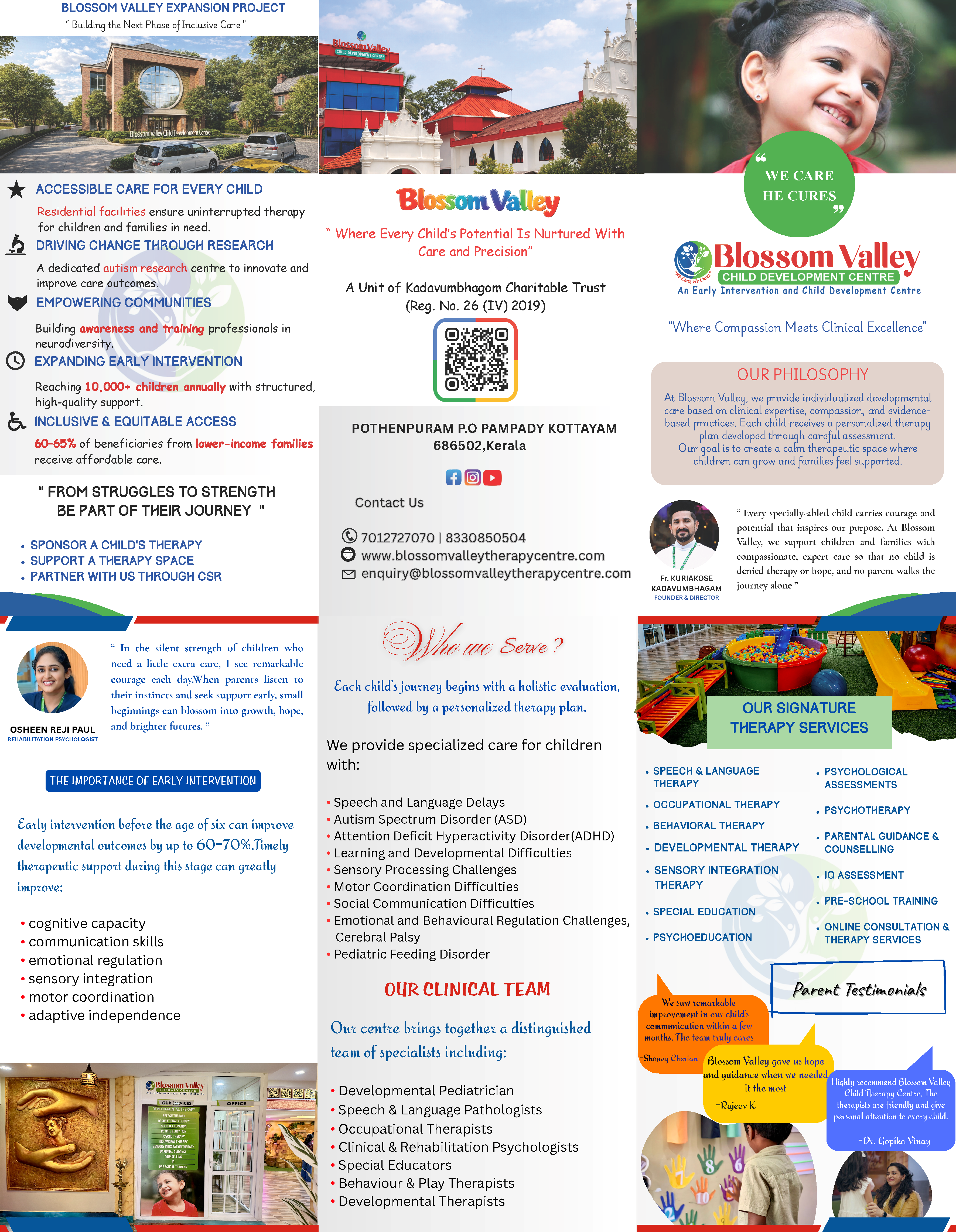
At Blossom Valley, we believe strongly in a family centered practice. Parents are given guidance that can be used in everyday routines, helping them understand their child's behaviour and communication and support newly learned skills.
For families dealing with autism, parent training for autism can be particularly valuable. It helps parents respond consistently and confidently to their child's needs.
Support Beyond Autism
A child may need assessment or support for many different reasons, including ADHD, Specific Learning Disability (SLD), Intellectual Disability (ID), sensory processing difficulties, developmental delay, or emotional and behavioural concerns.
Older children and teenagers may also benefit from adolescence counseling or teenage counseling when they experience difficulties with emotions, relationships, school, attention, or self confidence.
The important point is that assessment should look at the whole child not just one symptom.
Choosing the Right Support in Kottayam
For parents searching for an Autism Centre Kottayam, Autism Therapy Kottayam, Child Psychologist Kottayam, Early Intervention Centre Kottayam, or Multidisciplinary Child Development Centre Kottayam, it is important to look beyond a centre's name.
Look for qualified professionals, proper assessment, individualised therapy, family involvement, and a clear understanding of the child's developmental needs.
At Blossom Valley, our approach is centred on helping children develop meaningful skills at their own pace. Whether a child needs a developmental assessment, autism assessment, behavioural support, speech therapy, occupational therapy, or other specialised intervention, our focus remains the same: understand the child first, then build the right support around them.
Early concerns deserve early attention. If you notice a loss of previously acquired skills, speaking with a qualified professional can be an important first step.
FAQs:
What is developmental regression?
Developmental regression is the loss or reduction of skills that a child had previously developed, such as speech, social interaction, play, communication, or daily living skills.
Does regression always mean autism?
No. Regression can have different causes. Although it can occur in children with Autism Spectrum Disorder, a professional assessment is needed to understand the reason.
When should parents seek a developmental assessment?
Parents should consider an assessment if they notice loss of skills, speech delay, changes in behaviour, social difficulties, learning problems, attention concerns, or unusual sensory responses.
Can early intervention help children with developmental delays?
Early intervention can help children build communication, behavioural, social, motor, cognitive, and daily living skills. The type of therapy should be based on the child's individual assessment.
Where can I find autism assessment and therapy in Kottayam?
Families looking for autism assessment, autism therapy, developmental assessment, or early intervention in Kottayam can consult a qualified child development centre such as Blossom Valley to understand the appropriate next steps.