- +918330850504
- enquiry@blossomvalleytherapycentre.com
- Mon – Sat: 8:30 AM – 5:00 PM

- by admin
- August 31, 2026
- No Comments
From Assessment to Improvement: How CBT, Psychotherapy, and ABA Therapy Create Better Outcomes for Children
Every child is different. Some children begin speaking early, while others take more time. Some find it easy to make friends and follow instructions, while others may struggle with communication, attention, behavior, or everyday activities.
The important thing is not to compare one child with another. What matters is understanding why a child is finding something difficult and what kind of support can help.
This is where a proper developmental assessment becomes important.
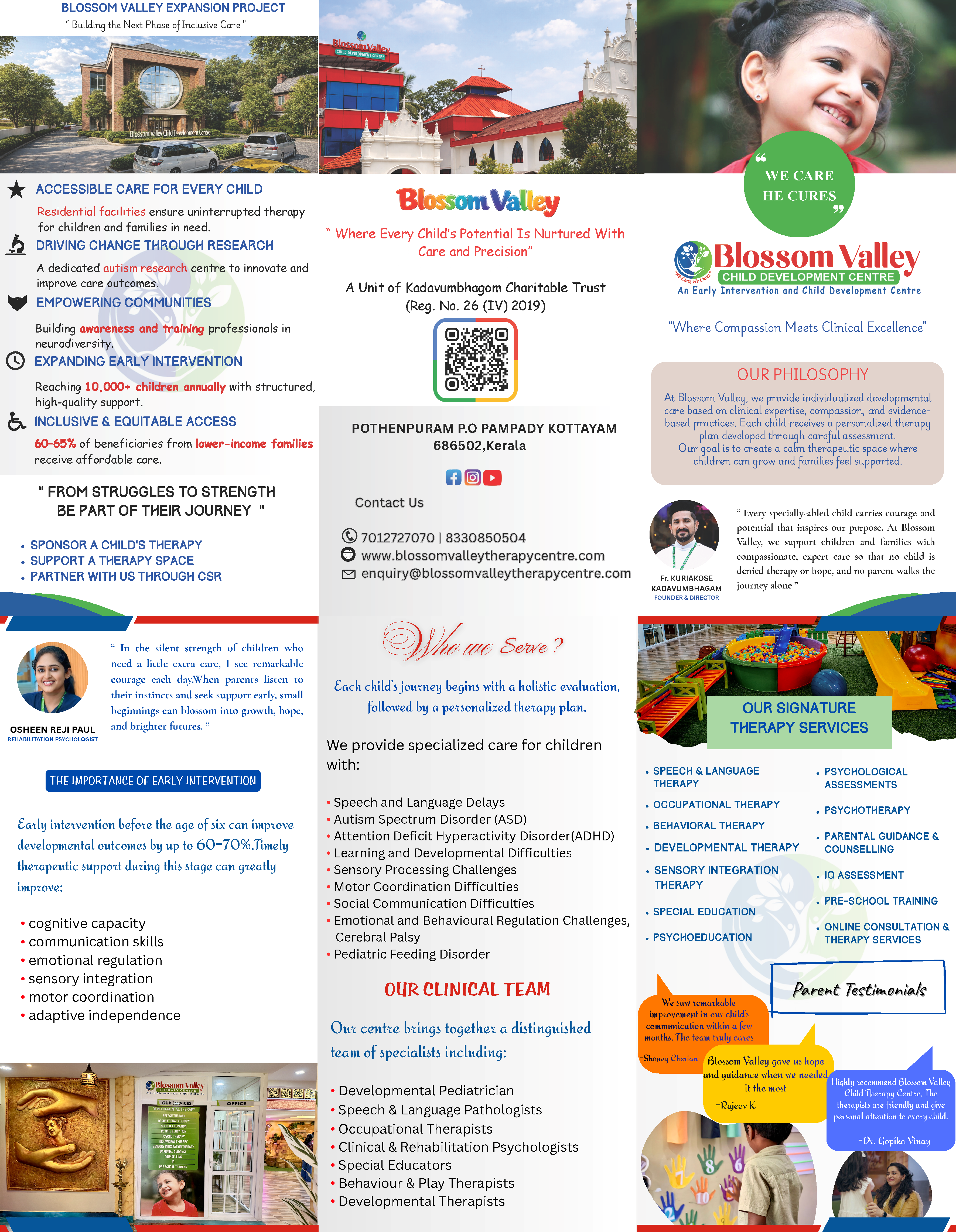
At Blossom Valley Child Development Centre, assessment is considered the starting point rather than the final answer. Once a child's strengths and difficulties are understood, therapists and psychologists can work with the family to develop a practical intervention plan. Depending on the child's needs, this may include Cognitive Behaviour Therapy (CBT), Psychotherapy, Applied Behaviour Analysis (ABA), Speech Therapy, Occupational Therapy, Developmental Therapy, Sensory Integration, or other forms of support.
A Good Assessment Looks Beyond the Obvious
Parents usually notice the first signs themselves.
A child may not be speaking as expected. Another child may have difficulty sitting and concentrating. Some children avoid social interaction, while others become extremely distressed by changes in routine. In some cases, parents may notice regression, where a child loses a skill they had previously developed.
These concerns should not simply be ignored with the hope that the child will "catch up."
A professional psychological assessment or developmental assessment can help provide a clearer understanding of what is happening. Depending on the concerns, this may include IQ Testing, Autism Assessment, ADHD Assessment, learning disability assessment, or evaluation of communication, behaviour, attention and cognitive skills.
The purpose of assessment is not to put a label on a child. It is to understand the child better.
That understanding makes therapy more focused and meaningful.
CBT Can Help Children Understand Their Feelings
Children do not always have the words to explain what they are feeling.
A child may become angry when they are actually anxious. Another may avoid school because they are worried about making mistakes. Teenagers may withdraw from their families when they are dealing with emotions they do not know how to manage.
Cognitive Behaviour Therapy (CBT) can help children and adolescents recognise their thoughts, feelings and behaviours and learn healthier ways of responding.
For older children and teenagers, adolescence counselling or teenage counselling can provide a safe place to discuss concerns related to confidence, relationships, school, anxiety, emotional changes and other challenges.
CBT is not about telling a child to "think positively." Good therapy takes time to understand what the child is experiencing and teaches practical skills that can be used in real life situations.
Psychotherapy Gives Children a Safe Space
Sometimes a child simply needs a place where they can be heard without feeling judged.
Psychotherapy can support children who are experiencing emotional, behavioural or psychological difficulties. Through age appropriate approaches, a therapist can help a child express emotions, understand difficult experiences and develop better coping skills.
The approach used with a young child will naturally be different from the approach used with a teenager. Experienced professionals understand that children communicate in different ways, and therapy needs to be adapted accordingly.
Where ABA Therapy Can Make a Difference
For children with Autism Spectrum Disorder (ASD) and certain developmental or behavioural challenges, Applied Behaviour Analysis (ABA) can be an important part of intervention.
ABA focuses on understanding behaviour and teaching useful skills in a structured and measurable way. The aim is not simply to stop unwanted behaviour. A good ABA programme looks at why the behaviour is happening and what skill the child may need to learn instead.
Depending on the child's individual needs, ABA therapy may support communication, social interaction, attention, learning, self care, following instructions and behaviour management.
Behaviour Management and Behaviour Modification can be particularly helpful when challenging behaviours interfere with a child's ability to learn or participate in everyday activities.
The involvement of appropriately trained professionals, including a Qualified Behaviour Analysis (QBA) professional where relevant, can help ensure that behavioural strategies are planned around the child's actual needs.

Children Often Need More Than One Type of Therapy
One of the biggest lessons in child development is that difficulties rarely exist in isolation.
A child with autism may have communication difficulties as well as sensory challenges. A child with speech delay may also struggle with social interaction. A child with motor difficulties may find dressing, eating or other daily activities challenging.
This is why a multidisciplinary child development centre can be so valuable.
At Blossom Valley, intervention can bring together different areas of support when required, including:
- Speech Therapy for Autism and communication development
- Occupational Therapy for Autism
- Sensory Integration Therapy
- Developmental Therapy
- Fine Motor and Gross Motor Skills training
- ADL Skills for everyday independence
- Social Skills Training
- Cognitive Skills Training
- Attention Enhancement
- PECS (Picture Exchange Communication System)
- Special Education for Autism
- Parent Training for Autism
Not every child needs all of these services. The right combination depends on the child's assessment and individual goals.
That is an important distinction. Therapy should be designed around the child, not the other way around.
Early Intervention Is About Giving Children More Opportunities
The earlier a developmental concern is understood, the sooner appropriate support can begin.
This is especially important during the preschool years. Young children are developing communication, movement, social skills, independence and learning abilities very quickly.
Preschool developmental support and play based therapy can make therapy feel less like a clinical activity and more like a natural part of the child's development.
Through play, children can practise communication, turn taking, problem solving, movement, social interaction and emotional regulation without feeling that they are being tested.
Parents also play a major role.
A family centered practice recognises that therapy does not end when the child leaves the centre. The strategies used by therapists can be carried into the home, school and community when parents are given the right guidance.
When Should Parents Consider an Assessment?
There is no single sign that means a child definitely has autism or another developmental condition. However, parents should consider professional advice if they notice persistent concerns such as:
- Delayed speech or difficulty communicating
- Loss of previously acquired skills
- Limited social interaction
- Repetitive behaviours
- Difficulty responding to their name
- Significant attention or behaviour difficulties
- Problems with learning
- Unusual reactions to sounds, textures or movement
- Delays in fine or gross motor skills
- Difficulty with everyday self care
- Concerns about autism, ADHD, learning difficulties or intellectual development
Parents searching for Autism Symptoms in Children, Speech Delay and Autism, Autism Screening Near Me, or Early Autism Detection should remember that online information can be useful for awareness, but it cannot replace a professional assessment.
If something does not feel right, it is reasonable to ask for guidance.
Supporting the Whole Child
Good child development care is not about changing a child into someone they are not.
It is about helping them communicate more effectively, become more independent, manage emotions, learn new skills and participate more comfortably in everyday life.
For one child, that may mean ABA Therapy and social skills training. For another, it may involve speech therapy and occupational therapy. Someone else may benefit from CBT or psychotherapy. In many cases, a combination of therapies provides the most useful support.
This individualized approach is particularly important when supporting children with ASD, ADHD, Specific Learning Difficulties (SLD), Intellectual Disability (ID), developmental delays, or other neurodevelopmental disorders.
Finding the Right Child Development Support in Kottayam
For families looking for an Autism Centre in Kottayam, choosing a therapy centre should involve more than simply looking at the number of services offered.
Parents should consider whether the professionals take time to understand their child, whether assessments are carried out properly, whether therapy goals are clearly explained, and whether parents are included in the process.
Families searching for Autism Therapy Kottayam, Child Psychologist Kottayam, Early Intervention Centre Kottayam, Learning Disability Assessment Kottayam, ADHD Assessment Kottayam, Sensory Integration Therapy Kottayam, or a Multidisciplinary Child Development Centre Kottayam can look for a centre where different professionals work together around the child's needs.
At Blossom Valley, the focus is on understanding the child first and then building an appropriate path forward through assessment, therapy and family involvement.
FAQs:
What is the purpose of a developmental assessment?
A developmental assessment helps professionals understand a child's development across areas such as communication, learning, behaviour, social interaction, motor skills and daily living. It helps guide the next steps in intervention.
Does every child with speech delay have autism?
No. Speech delay can have many causes, and having a speech delay does not automatically mean that a child has autism. However, if speech difficulties occur along with social communication differences or other developmental concerns, an assessment may be useful.
How can ABA therapy help a child with autism?
ABA therapy can help children develop practical skills such as communication, attention, social interaction, learning, self care and appropriate behavior. The program should be individualized according to the child's needs.
What does occupational therapy do for children with autism?
Occupational therapy can support areas such as sensory processing, coordination, fine and gross motor skills, self care and everyday activities. The goals depend on what the child finds difficult in daily life.
When is CBT suitable for children?
CBT may be helpful for children and teenagers experiencing concerns such as anxiety, emotional difficulties, negative thought patterns, behavioral challenges or low confidence. The approach is adapted to the child's age and ability to understand.
Why is parent training important?
Parents spend far more time with their child than any therapist can. Parent Training for Autism can help families understand their child's behavior and use appropriate strategies consistently at home and in everyday situations.
Where can I find autism therapy in Kottayam?
Families looking for Autism Therapy in Kottayam can consider a multidisciplinary centre such as Blossom Valley, where assessment and different developmental and therapeutic services can be coordinated according to the child's needs.
Final Thoughts
A child's development is a journey, and there is rarely one solution that works for everyone.
The most valuable first step is often a careful assessment followed by a therapy plan that makes sense for that particular child. Whether the right support involves CBT, Psychotherapy, ABA Therapy, Speech Therapy, Occupational Therapy, Sensory Integration, Developmental Therapy, or a combination of services, the goal should remain the same: helping the child build useful skills and enjoy a more independent and fulfilling life.
At Blossom Valley Child Development Centre, every child is approached as an individual. With early identification, professional guidance, family involvement and consistent support, small improvements can become meaningful progress over time.